


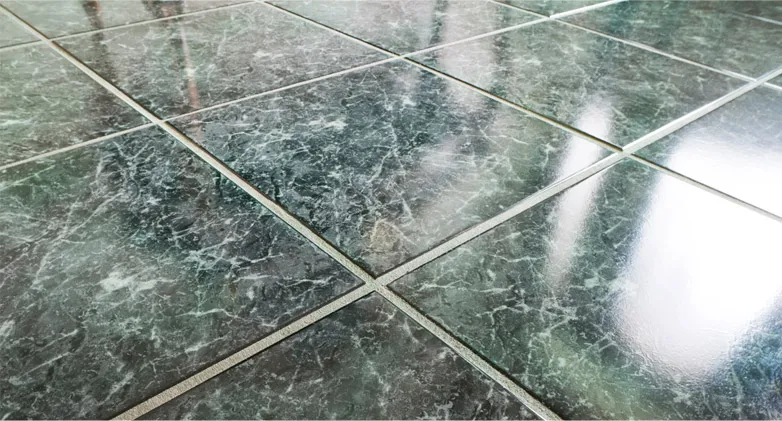
Grinding and honing are diamond-abrasive processes that remove scratches, etching, lippage, and uneven surfaces from natural stone and tile. Grinding levels a floor and removes deep damage using coarse diamond pads, while honing follows with progressively finer grits to leave a smooth, matte-to-satin finish ready for polishing or sealing.
Can Grinding and Honing Remove Deep Scratches and Etching?
Yes, grinding is one of the few processes capable of removing deep scratches, chips, and etch marks that surface polishing alone cannot fix. While light etching from acidic spills can sometimes be buffed out, deeper scratches and gouges have actually removed material from the stone, so the surrounding surface must be ground down to the same level using coarse diamond abrasives before the floor will look even again. We start with a low grit, typically in the 50 to 200 range, to remove the damaged layer and any lippage between tiles, then step up through progressively finer diamond grits to refine the surface and erase the scratch marks left by the coarser pass. Honing follows to smooth the stone to a consistent, uniform sheen. Timelines depend on stone hardness and the extent of damage, but most residential rooms are completed in one to two days, after which the surface is ready for polishing or sealing.
When Grinding & Honing Makes Sense
This service is typically the right call when you notice:
- Deep scratches or gouges that catch a fingernail
- Lippage, where the edge of one tile sits higher than its neighbor
- Dull etch marks left by acidic spills such as wine, juice, or vinegar
- An uneven, wavy floor surface from an old or poor installation
- A stone floor that has never held a consistent shine no matter how it is polished
Grinding and honing work on marble, travertine, limestone, granite, and most natural stone and tile installations. Because it removes a thin layer of material, we assess your stone’s thickness and condition before starting to make sure the surface can be safely reground. We serve homes and businesses across Rancho Mirage, La Quinta, Indio, Bermuda Dunes, and the rest of the Coachella Valley.
Frequently Asked Questions
What is the difference between grinding and honing?
Grinding uses coarse diamond abrasives to remove deep damage, level lippage, and correct an uneven surface. Honing follows with progressively finer grits to smooth the stone into a consistent matte or satin finish. Grinding fixes structural surface problems; honing refines the finish afterward.
Will grinding make my floor slippery?
A honed finish is generally less slippery than a highly polished one because it has more surface texture, which is one reason many homeowners choose honing for bathrooms, entries, and pool-adjacent areas where traction matters.
Does grinding and honing work on all types of stone?
Most natural stones, including marble, travertine, limestone, and granite, can be ground and honed. Softer stones respond differently than harder ones, so we evaluate your specific material and its thickness before recommending a grit sequence and process.
Do I need to reseal my floor after grinding and honing?
Yes. Grinding removes the stone’s existing surface along with any prior sealer, so the freshly honed floor is left porous and should be sealed afterward to protect it from stains and moisture going forward.
Ready to get started?
Contact Wesley Preston Restoration today for a free, no-obligation quote. CA Contractor License #960526.